Showing posts with label Ragtime. Show all posts

Friday, January 4, 2013

Pork and Beans

Since January is the month of resolutions and diets, I thought I’d focus on a food-related cover this month. Pork and Beans is a one/two-step written in 1913 by a fellow with the unusual name of C. Luckyth Roberts. I don’t think I’ve ever heard of another person with the moniker “Luckyth”, and it’s unusual enough that I think I would remember if I had. Mr. Roberts is far from a lost name in ragtime, stride piano, and blues music, though.


Charles Roberts was born in 1887 in Philadelphia, PA and began his showbiz life early, touring with the Uncle Tom’s Cabin Company at the age of three and later with Gus Seeker’s and Mayme Remington’s Ethiopian Prodigies. He took up the piano at five and first played professionally in Philadelphia and moved to Harlem, NY in 1910.

Roberts founded the Harlem piano school, writing rags that inspired more complex compositions later in the ragtime era. Roberts influenced ragtime greats such as James P. Johnson, Fats Waller, Duke Ellington, and Willie-the-Lion Smith. Roberts toured Europe with James Reese Europe in 1915 and was music director for The Smart Set, a review show with a connection to Logansport, IN through its founders Salem Tutt Whitney and J. Homer Tutt, between 1913 and 1919. Roberts played Carnegie Hall and remained active as a soloist and band leader into the 1960’s.

As for the sheet music art, it’s a kind of cubist rendition of a pig apparently contemplating contributing to the bean pot. I’m always a little weirded out by artwork that features animals gladly going to slaughter or talking food and this one’s no exception. It’s a pretty simple image, nice bold colors, an easy connection with the theme. I even found a very nice recording of Pork and Beans on YouTube.


Tuesday, October 27, 2009

Ghost Dance

I went shopping the web for a Halloween-like sheet music cover and I came up with the Ghost Dance – which, apparently, is a "dance descriptive". What, exactly, would a "dance descriptive" be? I can't seem to find a resource that describes, dance descriptive. Maybe the whole dance descriptive genre is indescribable – which seems to make an oxymoron of this whole piece of sheet music. Then again, I dig oxymorons so it just attracted me more. The appropriateness of having a piece of sheet music titled ghost-anything just sealed the deal! Get it - ghost...sheet...is this thing on?

Cora Salisbury's sheet music might be fairly easy to find on the web but you have to dig deep to find much information about the composer's life. That seems odd considering there aren't too many female ragtime composers that I'm aware of - seems to me that Cora isn't getting her due. Professor Bill Edwards' amazing site provided this snippet:


"It was potentially around 1907 that Cora created a vaudeville act and started to travel, most likely with a small troupe of performers. One of her first published compositions was Poodles Parade in 1907, which was printed by Thiebes Stierlin in St. Louis, further suggesting that she was traveling in that time frame. The following year saw another piece in print, My Light Guitar under the logo of Will Rossiter in Chicago, extremely hard to locate today so likely in a small run. In 1909 her most famous piece found its way into print, Lemons and Limes: A Sour Rag, also published by Rossiter. It mentions a piece she had composed called Love's Embrace, but the existence of this waltz in print is difficult to verify. In the 1910 Census it is difficult to pinpoint either Cora or Eliza, so one or both may have simply missed the local Census takers while on the road. One more composition would come from Cora during these years of travel, albeit still based in Wisconsin. This was Ghost Dance, a novelette published by Rossiter, That would be the end of published compositions by Cora Salisbury, but one of her best acts was yet to come."

There is a lot more – her divorce, re-marriage, being widowed, and eventually becoming part of a vaudeville troupe. Mostly there's the real evidence that Cora wasn't going to be beaten down by the trials and travails of life. She was no Polly Purebred tied to the railroad tracks waiting for her Dudley Doright. Regardless of what you might think about ragtime music or even her ragtime music, you've got to respect her. Or, if you don't respect her for her musicality, you should know that she tutored one Ben Benny who'd later change his name to Jack Benny and go on to a lauded career in comedy. Benny credited Cora for teaching him stagecraft and I get the feeling it's credit she deserved.

As for the cover art, pretty basic monotone work. Our gypsy-esque ghostie is cavorting in some pine grove. Knowing that Cora haled from Wisconsin's lumber-belt, maybe the artist was a local or maybe she had some input into the design. I like to think that this little grove represents some memory she had of the days when her dad sharpened saws for the lumber mill. Otherwise, it's nondescript to the point of being dull. Many ragtime pieces have fantastic, fanciful cover art but this isn't one of them. The art work didn't catch me – it was Cora's story and I thought she deserved a little remembrance – even if it's in a smallish blog like ours.

Thursday, May 7, 2009

The Cute Little Wigglin' Dance

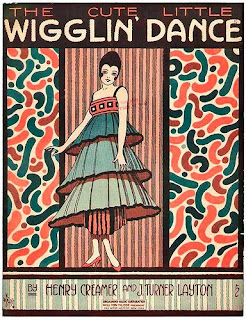
The Cute Little Wigglin Dance cover artI had a few moments during lunch today so I set out to harvest some graphics for the blog. I'm like a Viking when it comes to old graphics. I set forth in my computerized longboat, scouring the shores of distant lands for old ads, articles, paintings, and the like which I can loot. Then I return to my little cyber-village with my hoard, happy and ready to feast. You've seen the results of some of these forays – adulterated ads from the 40's and 50's that don't promote anything but a general sense of weirdness. It's fun and it satisfies my penitent for graffiti without requiring spray paint or the chance of going to jail.

Well, today I found myself on the waters of old sheet music and I started perusing cover art. There is some amazing cover art for the music of the teens, twenties, and thirties. After that it all becomes muggy headshots of Sinatra or Elvis done in low res on a purple or blue or pink background. The ragtime era stuff is much more inventive if you can stomach occasional racist imagery and titles. I tend to like the covers with a deco flare and that (along with the weird title) drew me to the piece of sheet music I'm writing about today.

"The Cute Little Wigglin' Dance" had me at 'wigglin' dance'. I mean, that's such a visual: what exactly is the wigglin' dance? What sorts of steps does it have? On what occasion would you do the wigglin' dance? Part of me thinks it’s a great euphemism for really having to pee yet another part of me wants to make it a lot bawdier. You know the Victorians came up with names for body parts just so they wouldn't have to say 'leg' in public so maybe it's no different with wigglin' dance?

The artwork's got it all. Look at that bullet hat the poor girl's wearing. Is she dancing or is she about to be shot from a cannon? She's dressed in some kind of triple-decker dervish dress that's flaring out in spite of the fact she seems to be standing still. Maybe each layer is supported by some kind of cantilever system? Maybe this is a whole new and sadistic use of underwire? Of course, in the teens definition of modesty she's wearing an ankle-length underskirt in spite of the fact the bottom layer of her dress extends past her knees. Wouldn't want anyone thinking she's got loose morals – even if they might mistake her for an extra off the last Flash Gordon movie. Hey, at least she's wearing sensible shoes. Oh, and did you notice she's surrounded by huge mutant bacteria? Maybe the wigglin' dance is actually the last stage in some horrid, early 20th century plague that claimed the lives of youth during the ragtime era? Maybe this woman is dressed in the traditional garb of a culture that was wiped from the face of the earth by the unstoppable advance of the wigglin' dance epidemic of 1919? Only this bit of paper remains to tell of their once glorious civilization.

The song's architects actually have a pedigree worth mentioning. John Turner Layton (1894 – 1978) penned the music for "Way Down Yonder in New Orleans" in 1922 (used in an Astaire/Rogers dance number in the film The Story of Vernon and Irene Castle (1939)) and "Whoa Tillie" (1923) which was popularized by Bessie Smith. Layton also performed in Vaudeville and eventually moved to England where he performed up into the 1960's. Henry Creamer (1879 – 1930) was the lyricist of the pair, writing the words to such songs as "After You've Gone" which Sophie Tucker popularized. In 1924 when he parted company with Layton, Creamer teamed with pianist James P. Johnson and contributed to such songs as "Alabama Stomp" and Ruth Etting's "If I Could be You". Creamer founded Club Clef with James Reese Europe in 1920.

I found the song on Rhapsody. It was performed by the Frisco Jass Band (no, not a typo, it's supposed to be 'ss'). It's a bouncy piece (I guess a wigglin' dance should be bouncy) with a sloppy trombone bit and a New Orleans feeling clarinet. Unfortunately, the version I heard didn't include any lyrics but I imagine they'd be the sort of words that would strike Bertie Wooster as 'pippy'. I'll never know, I guess. For now the lyrics are lost to time and maybe that's just as well. Sometimes when you actually reach back into the past and get hold of something like The Cute Little Wigglin' Dance you come back disappointed; it turns out to be less than you imagined. I won't stop looking though because I've got to know how Creamer described his 'wigglin' dance'. Hey, who knows what else I might find while I'm looking!

Saturday, August 16, 2008

They Don't Swing Like They Used To

Kelly and I, cutting the rug...
Last night I got the opportunity to attend a powwow of the Classic Ragtime Society of Indianapolis. I like ragtime - for the most part it's bubbly and happy and it makes me tap my feet and think about times long gone by. There are some real hot pianists who play the society's gig including a 16 year old kid who's got more going before he can order a beer than I do to this day. That was a little depressing - but I got over it.

One of the interesting bits, though, was a group of period dancers who came in costume to demonstrate some of the dances of the early 19th century. It was cool to see that a lot of the dances I'm learning now - the foxtrot especially - have really evolved over the decades. The one that really got me was the Charleston.

The Charleston I saw last night is not the Charleston I work into the Lindy Hop! It's a lot less together and a lot more athletic (if that's Kelly takes a spin with our niece, Ruthie...possible). I think I've come away with an understanding of where my dances are coming from and an appreciation for what I'm doing in comparison to the 'classic' versions.