Showing posts with label 1930's. Show all posts

Friday, May 11, 2012

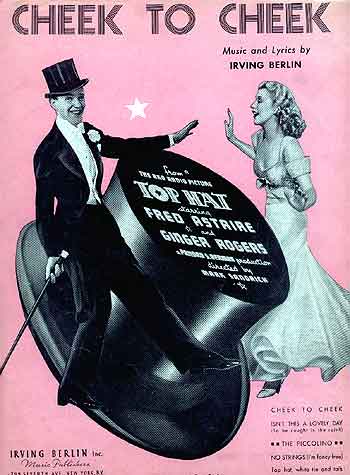
Cheek to Cheek

"Dance with me

I want my arm about you
The charm about you
Will carry me through to


Heaven, I'm in Heaven
And my heart beats so that I can hardly speak
And I seem to find the happiness I seek
When we're out together dancing cheek to cheek"

Irving Berlin wrote Cheek to Cheek for the Fred Astaire and Ginger Rogers movie Top Hat (1935). The song was nominated for the Best Song Academy Award for 1936, which it lost to Lullaby of Broadway. Astaire's recording of the song spent five weeks at #1 on Your Hit Parade and was named the song of 1935 and it’s been recorded numerous times by a variety of artists since its debut.

I love the cover of this piece of sheet music for its dance theme but I have to admit it’s not exactly imaginative. Doubtlessly the publisher was relying on Astaire and Rogers’ images to sell the sheet music and the prominent placing of the movie title tied the piece back to the movie. I guess it does look a little like Fred is more concerned about what the audience is thinking than Ginger, but I've seen a lot worse!

Tuesday, March 1, 2011

I Won't Dance

The thirties were a time of musicals. Maybe the Great Depression drove people to escape from reality and there's nothing more unreal than the musical genre. While the guys who used to put up skyscrapers are standing on breadlines, for a nickle you could watch chorus lines, extravagant costumes, and thinly defined plots reel out in black and white.

In 1934 one such musical came out in London. The Three Sisters, written by Jerome Kern and lyricist Oscar Hammerstein II, had only 72 performances. However, one of the songs featured in the play, I Won't Dance, was reused in the highly successful 1935 film Roberta. That version of the song, the one commonly sung thereafter, featured heavily revised lyrics by Dorothy Fields and Jimmy McHugh. Otto Harbach had had a hand in writing the lyrics for the original version with Hammerstein. Kern's music remained the same for the film rendition.

I Won't Dance originally was intended as a duet, portraying a dialogue between a woman and man, the former telling him what he is missing by not dancing with her, while the reluctant man gradually caves into her charms. The version of I Won't Dance I first encountered had been rewritten for solo vocalist and possibly the best known version is by Frank Sinatra. Regardless, I get swept away by the music and lyrics and find myself singing along (with various degrees of lyrical accuracy and little or no ability to carry a tune) every time I hear it.

I won't dance, don't ask me

I won't dance, don't ask me
I won't dance, Madame, with you

Say, you know what? You're lovely
You know what? You're lovely, but oh, what you do to me
I'm like an ocean wave that's bumped on the shore
I feel so absolutely stumped on the floor

When you dance you're charming and you're gentle
'Specially when you do the Continental
But this feeling isn't purely mental
For heaven rest us, I'm not asbestos

And that's why I won't dance, why should I?
I won't dance, how could I? I won't dance
Merci beau coup, I know that music leads the way to romance
So if I hold you in my arms I won't dance

Monday, November 30, 2009

It's a Wonderful Life

Maybe the 20's and 30's are starting to come around again. Both decades were marked by a fad for dance contests and the current craze for Dancing with the Stars and So you Think you can Dance sort of look back to that trend. I'm not sure what to attribute the 20's/30's fad to and I don't feel like I can comment with too much authority since I wasn't there to experience either era. As for the modern trend? Personally I link it with my reason so many people have a taste for reality shows: you can watch people acting like idiots without their behavior impacting you personally.

Those of you who've read Blue Suede Souls know I've got a real nostalgic streak but that streak doesn't extend to the fad for dance contests. There are a couple of reasons for this (and they apply to the modern fad too). First off, the whole idea that any judge or panel of judges could, on any given day, make a decision on who is the 'best' at any dance style (or worse, compare say Waltz and Jive and come up with a 'best') is ridiculous. It falls into that old algebraic conundrum of dissimilar terms, they can't be compared.

Another difference between the 'good ole' days' and modern times is that in the 20's/30's there seemed to be a focus on quantity rather than quality. Dance marathons were the rage with contestants dancing to the point of barely remaining upright so that they could win cash prizes. Maybe this was just part of 20's youth culture – an emphasis on virility, endurance, and strength over refinement, skill, and experience. As I said earlier, I'm not qualified to interpret and I can only imagine what the experience must have been like. Jam 200 teen-somethings onto an improvised (or actual) dance floor and the band kicks off the event with all the festiveness of the first day of a carnival. After a few hours the weaklings are culled from the heard, after a dozen hours only the most determined remain and the crowd of onlookers thins. Sometime after about twenty hours the crowd returns to see the end, it's like waiting for a matador to dispatch the bloodied beast he's been tormenting. Finally one of the couples drop and the other is crowned victorious. The swell of adrenalin is just enough to get them to smile for the photos – then they're asleep before they're out of the venue.


How do I hook this up with the holiday? Well, one of my very favorite movies contains a nice dance contest scene. It's a Wonderful Life depicts a Charleston Contest. George Bailey gets roped into accompanying Mary Hatch to a high school dance and then finds himself in the midst of a Charleston contest. I love the teetering on the edge of the pool portion of the scene – they move up and back, unaware they're about to plummet into the swimming slowly opening gymnasium swimming pool. Sometimes dancing feels like that scene. You're out there, having a good time and going at it like wild but totally unaware that disaster looms just at your heels. At least in the movie the disaster only ended in winning a loving cup and plundering the high school locker room for dry clothing! Anyway, I did my best to find a clip to show but You Tube came up bare. A still will have to do for this post. Maybe at some point the video will fall into my hands and I'll air it.

Oh, and a little something to show I'm not all about flashing back to the way things were in 1946 when It's a Wonderful Life is set. The movie contains one of the hardest scenes in cinematography for me to watch – the scene where drunken druggist Gower slaps a young George Bailey in the head until his ear bleeds. The violence is troubling enough by itself but the 'angelic' commentary provides a window into the thinking of the era. Clarence doesn't show a hint of horror at what has happened to George, he doesn't remark on the violence at all except to say 'is that the boy who got his ear slapped back…' when he sees Bailey as a grown man. Omission, for me at least, is acceptance of normality and that says a lot about the era of this film. I guess not all that's old glimmers with a soft, sepia-toned love light.

Wednesday, October 7, 2009

I Found a Million Dollar Baby (in a Five and Ten Cent Store)

As I've said before I love the cover art from sheet music. It's a quirky thing, visuals to represent music before the concept of television (not to mention the music video) was a subject for science fiction writers. The artwork on the covers reflects the mores of the time: you get the ugly prejudices, stereotypes, right along with the idealized visions of what the fine life was all about. Some of it is really high quality, some of it is grotesque and cartoonish, but it always is interesting.

Today I thought I'd go trawling through the internet again, searching for a cover to write about. I went to Google images and right on the first page was the cover for a song I knew, Million Dollar Baby. The lyrics for the song are penned by the famous Billy Rose and music was written by the equally famous Fred Fisher. Million Dollar Baby was written for Rose's 1931 Broadway review Crazy Quilt and after that it enjoyed popularity as a song standard performed by various artists including Bing Crosby. I think the sentiment of finding something of great value (or, more appropriately, someone of great value) at a place like Woolworths must have been very appealing as the great depression was just getting its teeth and claws into America. The high times of Puttin' on the Ritz were gone and we weren't quite to Brother can you Spare a Dime but the trajectory had led just about ever average citizen into the bargain basement. It's a nice thought - in the middle of facing the ugliness of economic woes you stumble upon a a pretty face among the cheap, knock-offs and shoddy merchandise and realize all that's gold doesn't glitter.

The cover of this particular printing of Million Dollar Baby proudly states "With Ukulele Accompaniment". There's something you don't see nowadays. I think if you went to a show and were told at the door, "Hey, did you know there's a ukulele accompaniment?" you'd probably turn and run with the specter of Tiny Tim nipping at your heals all the way home – and I don't mean the Dickensian character! Still, that doesn't deal with my most favorite part: the artwork.

Here we see a dear lass of the era holding up a tiny curio that is staked with a price of 10¢. In fact everything in the background bears the same price, 10¢. Makes you wonder why it's called a FIVE and ten cent store if everything in it costs ten cents? Maybe she's shopping the Bergman Sacs of bargain basements. None of that cheap five cent stuff here, we only carry top of the line! That taken as given it still doesn't explain the fact all of the prices are mounted on stakes that apparently are driven into the merchandise. Maybe that's why the stuff's being sold at a discount? De Havilland forgot to fire that batch of china – no problem, the poor sods in the states who'll buy it, mark it ten cents! Or maybe she's shopping in a store that specializes in marzipan that's shaped like dishes? Not that you'd want a stick driven through your dish-shaped marzipan but, it's an explanation (albeit not a good one).

By the way, a brief aside. When is the last time you typed the symbol for cents? Ever try to find it on a computer keyboard? Don't waste your time, the old lazy "c" isn't there any more. You've got to delve deep into the special character set to find the thing. Sign of our time, I guess. Still I like the cent sign a lot better than representing everything as some decimal part of a dollar. I mean can you imagine if the song had been called "I Found a Million Dollar Baby in a $0.05 and $0.10 Store"? There is no poetry in decimals, no romance at all. Not to mention they play jolly hell with the song's rhythm!

Turning my attention back to the artwork and away from the skewered dishes around the subject of our desire, I'm struck by a few things about this lovely, dime-store find. Firstly, she's a bit heavy handed with the blush don't you think? I've seen clowns with cheeks that weren't as fructose-infused-fake-apple red as this picture implies. Not to mention she's apparently applied her blush from bottom eyelid down past her cheekbones and back to her ears. Maybe that's not her fault. Maybe her roommate, Kongo the Gorilla, applied her blush this morning. Gorillas don't know a whit about good makeup. If you don't believe me just try to name three really good cosmetologists who are gorillas. Can't do it, can you? See, I told you.

Her posture is a bit troubling too. I can't decide if the artist was attempting to imply some weird perspective or if our million dollar baby should be wearing a back brace. I tend toward the perspective angle because when you take it in tandem with the circular matting around the picture you get the impression she's being watched through a hidden, dime-store peephole. Maybe she lives in a state where there's a thriving dime store peep-hole fetish community? I almost can hear the heavy breathing of some hot and bothered clerk. If you look closely she's casting a sloe-eyed glance toward the inferred spy with a smirk that makes her seem a lot less like the innocent victim. Oh, knows she's being watched...and she likes it! "Follow me to the gardening department if you're brave enough, you dime-store savage, you!"

There's one more thing I noticed. I don't mean to be crass but – does it look to you like she isn't wearing a bra? I mean, to use the parlance of the fashion channels, the girls aren't exactly well behaved. They seem to be off on their own individual errands if you get my drift. Drift does seem to be the appropriate term there. This of course means that our "Million Dollar Baby" is, in fact, a bra-less dime-store perv with a bad back and poor grooming habits. Good lord, now I've creeped myself out!